I Vibe-coded an open registry for AI agents
Container registries store bytes. They don't know what's inside. The Agent Registry is a governance layer for AI agents, skills, and MCP servers, built on A2A AgentCard, MCP server.json, and Agent Skills as native identity formats.
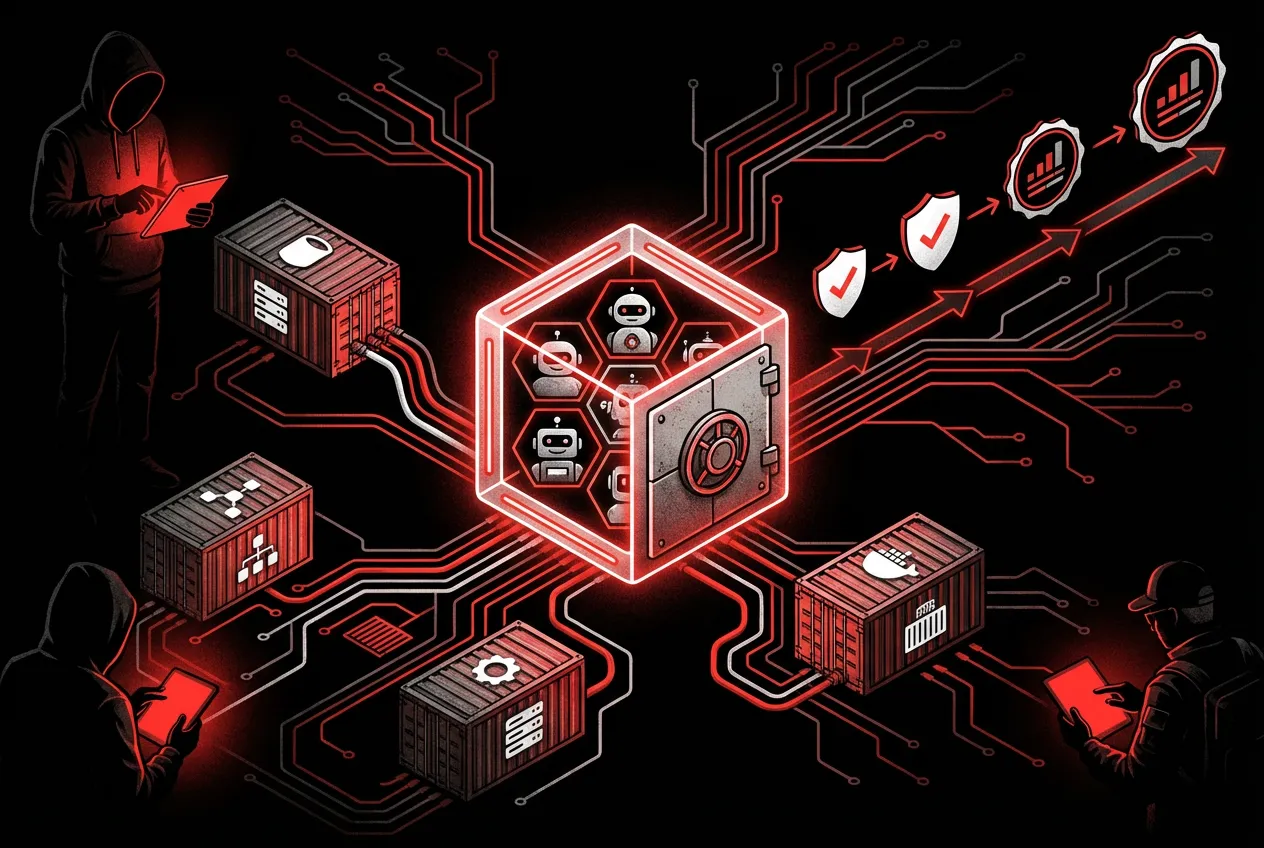
There’s a weird gap in the AI tooling ecosystem right now. We can build agents, deploy them in containers, connect them to MCP servers, give them skills and tools. But ask a basic question: “What models does this agent use? Has anyone evaluated it for safety? What MCP servers does it call? Who approved it for production?” and you get blank stares.
Container registries store bytes. They don’t know what’s inside. An OCI image tagged my-agent:v2.1 could use GPT-4o or a fine-tuned Llama, could call six MCP servers or none, could have been red-teamed or just vibed into production on a Friday afternoon. The registry doesn’t care. It stores layers and digests.
This felt like a problem worth solving.
Agents are containers with weird dependencies
Strip away the hype and an AI agent is an application. It runs in a container. It has a process, memory, a network port. You build it, push it to a registry, deploy it on Kubernetes. From an infrastructure perspective, it’s a workload like any other.
But the dependencies are unlike anything we’ve managed before.
A traditional microservice depends on libraries, databases, maybe an external API. You pin versions, you run CVE scans, you track the supply chain with SBOMs. Boring, well-understood, solved.
An AI agent depends on a model. That model is probabilistic. The same input can produce different outputs. Research measuring hallucination rates shows rates ranging from 3% on text summarization to over 90% on specialized tasks like legal citation generation. Industry reports indicate financial losses exceeding $250M annually from hallucination-related incidents. A UK police chief stepped down after an investigation was compromised by a Copilot hallucination.
And it gets worse when agents compose. Galileo’s research on multi-agent coordination found that boundary issues become particularly problematic in systems with adaptive agents. As agents expand or contract their perceived responsibilities, the boundaries between them shift unpredictably, creating inconsistent coverage that leads to hallucinations nobody anticipated.
The agent also depends on MCP servers, which are themselves services with their own dependencies and failure modes. And on skills, which are prompt bundles that may reference other skills. And on specific model providers, which may change pricing, deprecate versions, or alter behavior without warning.
So you have a container, sure. But the container’s behavior depends on a probability distribution, a chain of external tool servers, and prompt templates that may or may not work the same way after the model provider ships a new version on Tuesday.
Jimmy Song wrote that agents are evolving from tools into distributed systems, and single-agent designs resemble early monoliths: impressive demos, fragile behavior, opaque failure modes. Deloitte found that only 11% of organizations are actually running agents in production. 42% are still developing their strategy. The gap between “look at this demo” and “this runs in prod” has never been wider.
Traditional infrastructure tooling doesn’t capture any of this. Your container registry doesn’t know which model your agent calls. Your SBOM doesn’t list prompt templates. Your CI pipeline doesn’t track whether anyone ran a red-team evaluation before the last deploy.
That’s the gap.
The actual problem
I kept running into the same situation: teams building agents internally, deploying them, and then losing track of what depends on what. An agent uses a Kubernetes MCP server for cluster access. That MCP server gets updated. Did anyone check if the agent still works? Who knows, because nobody recorded that dependency.
The MCP ecosystem is growing fast. The official MCP Registry launched in preview in September 2025, and there are now 1,000+ servers in the community registry. Docker has an MCP catalog. GitHub has one too. Kong announced an enterprise MCP registry in February 2026.
But these registries focus on MCP server discovery. They answer “what MCP servers exist?” They don’t answer “what does this agent depend on, has it been evaluated, and is it safe to run in production?”
Microsoft’s Agent Registry in Copilot is interesting but locked to their ecosystem. Google’s Cloud API Registry integration in Vertex AI Agent Builder does something similar for their platform.
Nothing is vendor-neutral. Nothing works across frameworks. Nothing tracks the full supply chain of an agent: its models, its tools, its skills, its evaluation history, its promotion through a governance lifecycle.
What I built
The Agent Registry is a metadata store that sits alongside OCI registries. It doesn’t store containers or binaries. It stores structured metadata about three types of AI artifacts:
- Agents: autonomous AI systems with container runtimes, model dependencies, and tool integrations
- Skills: reusable prompt-based capability bundles (no runtime, think playbooks)
- MCP servers: Model Context Protocol servers that expose tools and resources
Here’s the part that changed since v0.1: the registry no longer invents its own identity schema. Each artifact kind now uses an existing open standard as its native format:
| Kind | Standard | Who runs it |
|---|---|---|
| Agent | A2A AgentCard | Google, Agentic AI Foundation |
| MCP Server | MCP server.json | Anthropic, Agentic AI Foundation |
| Skill | Agent Skills (SKILL.md) | Anthropic, 30+ platforms |
The A2A AgentCard is the most interesting one. It carries the agent’s name, version, skills, capabilities, security schemes, and cryptographic signatures. A colleague of mine (thank you Morgan Foster) pointed out that card signatures let you tie a particular agent card to a particular running workload cryptographically, which gives you a real attestation story without building anything custom. The MCP server.json covers package and transport metadata. The SKILL.md is the prompt instructions and tool requirements.
The registry wraps each of these with the stuff none of the standards handle: promotion lifecycle, evaluation records, a Bill of Materials, provenance, trust signals. The standard doc tells you what the thing is. The registry tells you if anyone has actually checked whether it works.
You can push an A2A AgentCard directly:
agentctl push agents agent-card.json \
    --namespace acme --oci ghcr.io/acme/my-agent:1.0.0
And export one back out for deployment:
agentctl get agents acme/my-agent 1.0.0 --format a2a > agent-card.json
# serve at /.well-known/agent-card.json
Or import from a running agent’s well-known endpoint:
agentctl import --from-a2a https://agent.example.com/.well-known/agent-card.json \
    --namespace acme --oci ghcr.io/acme/my-agent:1.0.0
This matters because Kagenti (the Kubernetes agent orchestration project) already uses A2A AgentCards for discovery. When your agent is in the registry, a deployment system can call the export endpoint, get a valid AgentCard, and serve it at /.well-known/agent-card.json without any translation. The standard doc goes in, governance gets layered on top, and the same standard doc comes back out when you need it.
The legacy YAML manifest format still works. Nothing breaks. But now the registry speaks the same language as the rest of the agent ecosystem.
It works with any agent framework. LangChain, CrewAI, ADK, Llama Stack, custom builds. The registry doesn’t care how you built the agent. It cares what the agent uses and whether anyone has checked if it’s safe.
The Bill of Materials
This is the part I think matters most. Every agent declares a Bill of Materials (BOM) that lists:
- What models it uses (and which provider, and what role: primary vs. fallback)
- What MCP servers it calls (with version constraints)
- What skills it composes
- What prompts it ships with (hashed for integrity)
You can resolve the full dependency tree with a single command:
agentctl deps agents acme/cluster-doctor 1.0.0agent acme/cluster-doctor@1.0.0
|- model granite-3.1-8b-instruct@ibm [resolved]
|- model llama-3.1-70b-instruct@meta [resolved]
|- mcp-server acme/kubernetes-mcp@>=2.0.0 [resolved]
|- mcp-server acme/prometheus-mcp@>=1.0.0 [resolved]
|- skill acme/k8s-troubleshooting@>=1.0.0 [resolved]This is what CoSAI has been calling for with AI SBOMs. The difference is I built the tooling that actually does it.
Evaluation records
The registry accepts evaluation results from external tools. It doesn’t run evaluations itself. Garak runs a toxicity scan? The registry stores the result. Eval-hub runs a benchmark? Same. A human reviewer signs off? That goes in too.
agentctl eval attach agents acme/cluster-doctor 1.0.0 \
    --category safety --provider garak \
    --benchmark toxicity-detection --score 0.96
Categories include safety, red-team, functional, and performance. Each record captures the provider, benchmark, score, evaluator identity, and method (automated, human, or hybrid).
McKinsey reported that 80% of organizations have already encountered risky behaviors from AI agents, including improper data exposure and unauthorized access. Having evaluation records attached to the artifact itself, not buried in a CI log somewhere, seems like the minimum bar.
Promotion lifecycle
Artifacts move through a governance lifecycle: draft, evaluated, approved, published, deprecated, archived. Each transition is gated and recorded.
draft --> evaluated --> approved --> published --> deprecated --> archivedMoving to evaluated requires at least one eval record. Content becomes immutable after that point. What was tested is what gets shipped. No sneaking in changes after the safety review.
Every promotion step records who did it, when, and why:
agentctl inspect agents acme/cluster-doctor 1.0.0agent acme/cluster-doctor@1.0.0
Status: published
Published: 2026-02-21T10:40:36Z
Eval Records: 3
safety 1 record(s)
red-team 1 record(s)
functional 1 record(s)
Average score: 0.92
Promotion History:
draft -> evaluated -- All evals pass
evaluated -> approved -- Reviewed by platform team
approved -> published -- Production-readyThe CLI and server
There are two entry points. agentctl is the CLI for pushing artifacts, running queries, and managing the registry. A separate server binary handles the HTTP API and embedded web UI. For local development, agentctl server start runs both in one process. For production, the server binary is what goes in the container.
# Local dev
go build -o agentctl ./cmd/agentctl
./agentctl server start

# Production container builds cmd/server
make image push deploy
The CLI also has an init command that scans your project source code with an LLM and generates a manifest. Point it at a directory with a Dockerfile, some Python or Go code, and a README, and it figures out the kind, extracts dependencies, and writes the YAML. Works with Anthropic, OpenAI, Ollama, vLLM, or any compatible endpoint.
agentctl init --path ./my-agent --image ghcr.io/acme/my-agent:1.0.0 -o manifest.yamlThere’s also an import command for when the agent already exists somewhere and publishes its A2A AgentCard:
agentctl import --from-a2a https://my-agent.example.com/.well-known/agent-card.json \
    --namespace acme --oci ghcr.io/acme/my-agent:1.0.0
Deployed on OpenShift
The registry runs on Kubernetes and OpenShift. I have a multi-stage Dockerfile, Kustomize overlays for both vanilla k8s and OpenShift, and a Makefile that does build, image, push, deploy in four commands.
make image push deployThe server uses SQLite for storage (swappable to Postgres), embeds a web UI, and runs as non-root with a read-only root filesystem. Passes OpenShift’s restricted SCC without any grants.
How this compares to agentregistry-dev
There’s an existing project called agentregistry that solves a related but different problem. It’s a runtime deployment system: you give it MCP servers, skills, and agents, and it manages running instances via Docker Compose and a reverse proxy gateway. It answers “how do I run these things locally?”
My project answers a different question: “how do I govern, version, and trust these things across environments?” The agentregistry-dev project has basic published/unpublished states but no formal promotion lifecycle, no evaluation record schema, and no transitive BOM resolution. It does have useful enrichment (GitHub stars, security scanning via OpenSSF Scorecard), but governance metadata lives outside the artifact.
They’re complementary. You could use agentregistry-dev to deploy locally and my registry to track what’s been evaluated, approved, and published for production. Different layers of the same problem.
Why this matters now
A Gartner analyst noted that MCP’s authentication and authorization model is limited. Tray.ai coined the term “Shadow MCP” for the growing problem of unmanaged MCP servers in enterprises. Tetrate wrote about securing the MCP supply chain as an infrastructure concern.
On Reddit, an MIT researcher posted in r/artificial asking “who’s actually feeling the chaos of multiple AI agents working together?” The responses were telling: coordination, compliance, and trust were the top pain points. In r/devops, “would you trust an AI agent in your cloud environment?” got mostly skeptical responses. In r/kubernetes, someone built an AI SRE, realized LLMs are terrible at infra, and rewrote it as a deterministic linter.
The pattern is clear: people are building agents, hitting trust and governance walls, and then either giving up or bolting on ad-hoc solutions. There’s no standard way to say “this agent has been safety-tested, here’s the proof, and here’s everything it depends on.”
That’s the gap I’m filling.
The bigger picture
Gartner expects 40% of enterprise applications to have task-specific agents built in by 2026, up from under 5% in 2025. Predictions suggest agentic AI will represent 10-15% of IT spending in 2026. But Gartner also predicts that over 40% of agentic AI projects will fail by 2027 because legacy systems can’t support modern AI execution demands.
The organizations that figure this out will be the ones that treat agents like what they are: applications with model dependencies and unpredictable behavior that need the same (or stricter) governance as any production service. Not magic. Not demos. Infrastructure.
OpenAI’s September 2025 research definitively showed that standard training procedures reward guessing over acknowledging uncertainty. Your agent would rather hallucinate an answer than say “I don’t know.” That’s a feature of the model, not a bug you can patch. The only defense is governance: evaluation before deployment, immutability after approval, and a clear record of what was tested.
Or as one r/kubernetes commenter put it: “the k8s community doesn’t hate AI agents. They hate deploying things they can’t reason about.” Fair enough.
We don’t have 100% convergence yet, but some protocols are getting more traction than others. A2A looks like it could become how agents identify themselves and discover each other. MCP has momentum as the tool interface. Agent Skills is gaining adoption for packaging reusable prompt capabilities. All three are heading toward the Agentic AI Foundation at the Linux Foundation, which helps. Whether these end up being the long-term winners is anyone’s guess, but they’re the best bets right now. What none of them cover is the governance question: has this been tested, who approved it, what does it depend on? That’s where the registry fits.
The Agent Registry is my attempt to make agents something you can reason about.
What’s in the repo
The agent-registry repo includes:
- Full Go implementation (CLI + server + embedded web UI)
- Standards-based schema: A2A AgentCard, MCP server.json, Agent Skills as native formats
- Import/export: push standard docs directly, export for deployment at
/.well-known/ - 8 JSON schemas (draft 2020-12) for all artifact types
- OpenAPI 3.1 REST API spec
- Dockerfile + Kustomize manifests for k8s and OpenShift
- Example manifests, A2A AgentCard and server.json examples
- Presentation deck covering the problem and architecture
The spec covers 12 sections including the data model, BOM structure, version model, promotion lifecycle, OCI integration, eval results, provenance (SLSA, Sigstore, SBOM), trust signals, access control, and federation between registry instances.
It’s Apache-2.0 licensed and works with any agent framework.
Try it
git clone https://github.com/agentoperations/agent-registry
cd agent-registry
make build
./bin/agent-registry  # starts server on :8080
Or deploy to your cluster:
make image push deployThis is an experiment. I’m figuring out what the right abstractions are for governing AI artifacts. If you’re dealing with similar problems, I’d like to hear about it.
The Agent Registry is an agentoperations project.