Beyond LLMs: The Whole Product Framework for AI
What Maslow's hierarchy of needs, Levitt's whole product model, and Geoffrey Moore's crossing the chasm can teach us about building AI products that actually ship.

Contents
This is Part 1 of a three-part series called “Beyond LLMs - 2026 Edition.” Part 2 covers the technical anatomy of agentic systems, and Part 3 tackles moats, distribution, and the value lifecycle.
Everyone’s building with LLMs right now. But shipping a model is not shipping a product. The gap between a working demo and something customers pay for is where most AI projects die — Gartner has estimated that around 80% of AI projects never make it to production. So before we get into the technical weeds of agents and compound systems (that’s Part 2), I want to talk about how to think about AI products.
Starting with Human Needs
Back in 1943, Abraham Maslow published “A Theory of Human Motivation” in Psychological Review. You’ve probably seen the pyramid: food and shelter at the base, then safety, belonging, self-esteem, and self-actualization at the top. People don’t care about self-actualization if they can’t eat.
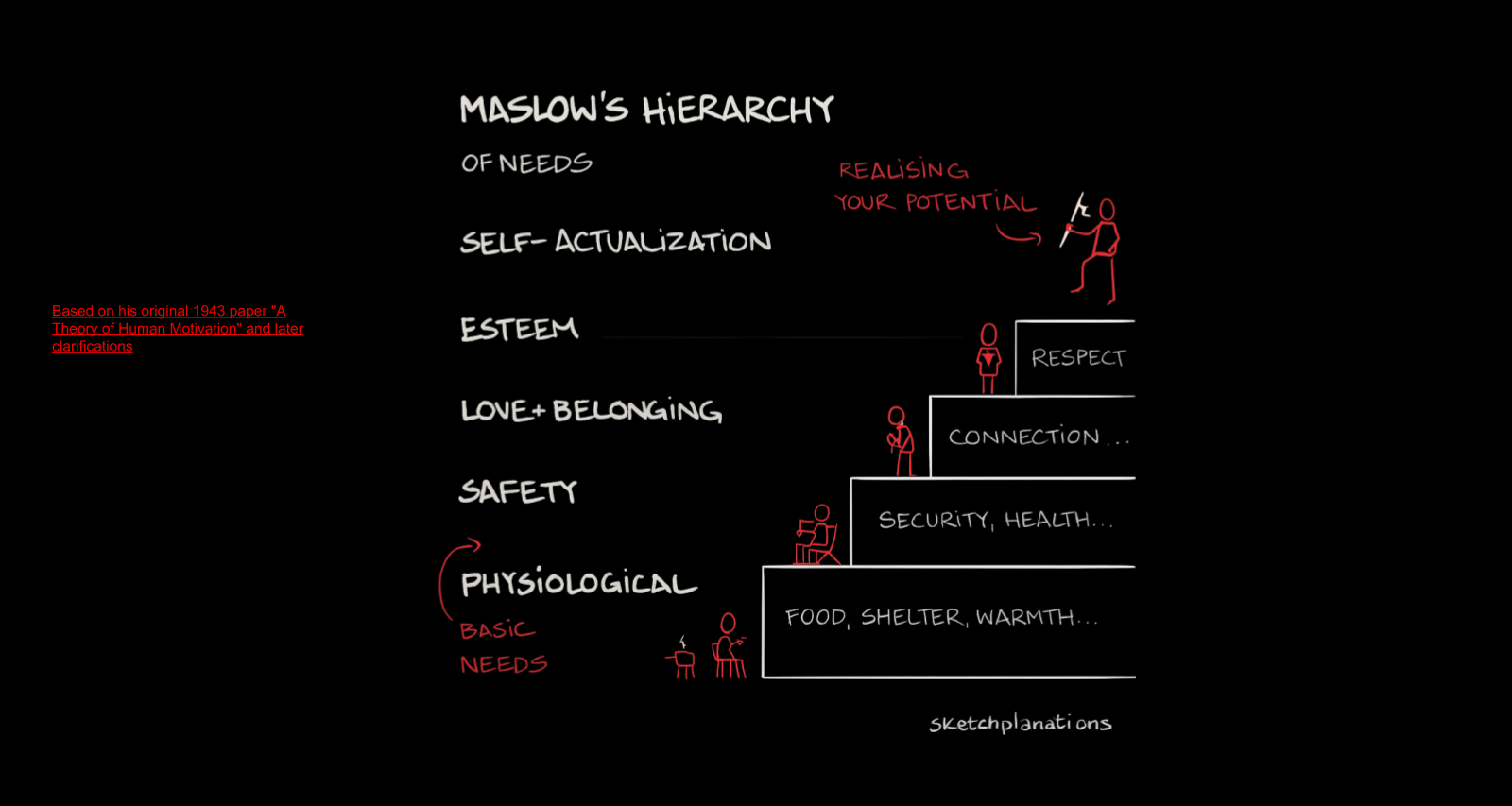
Products follow a similar layering. At the base, the thing has to work — that’s the core function. Above that, people expect certain basics: reliability, decent UX, documentation. Only after those are solid do users care about differentiating features, integrations, or ecosystem effects. Skip the base and nothing above it matters. Nobody cares about your plugin marketplace if the core product crashes.
Levitt’s Whole Product Model
Theodore Levitt, a Harvard Business School professor, first argued in his 1960 paper “Marketing Myopia” that companies fail when they define themselves by their product instead of by the customer need they serve. He later formalized the Whole Product Model in The Marketing Imagination (1983). It breaks a product into concentric layers:
The core product is the thing that performs the basic function. A smartphone makes phone calls. That’s it. Then there’s the expected product, what people assume comes with it: pre-installed apps, a charging cable, decent battery life. The augmented product adds differentiation: AppleCare, ecosystem integrations, third-party app store. And the potential product is what it could become. Apple Vision Pro, spatial computing, who knows.
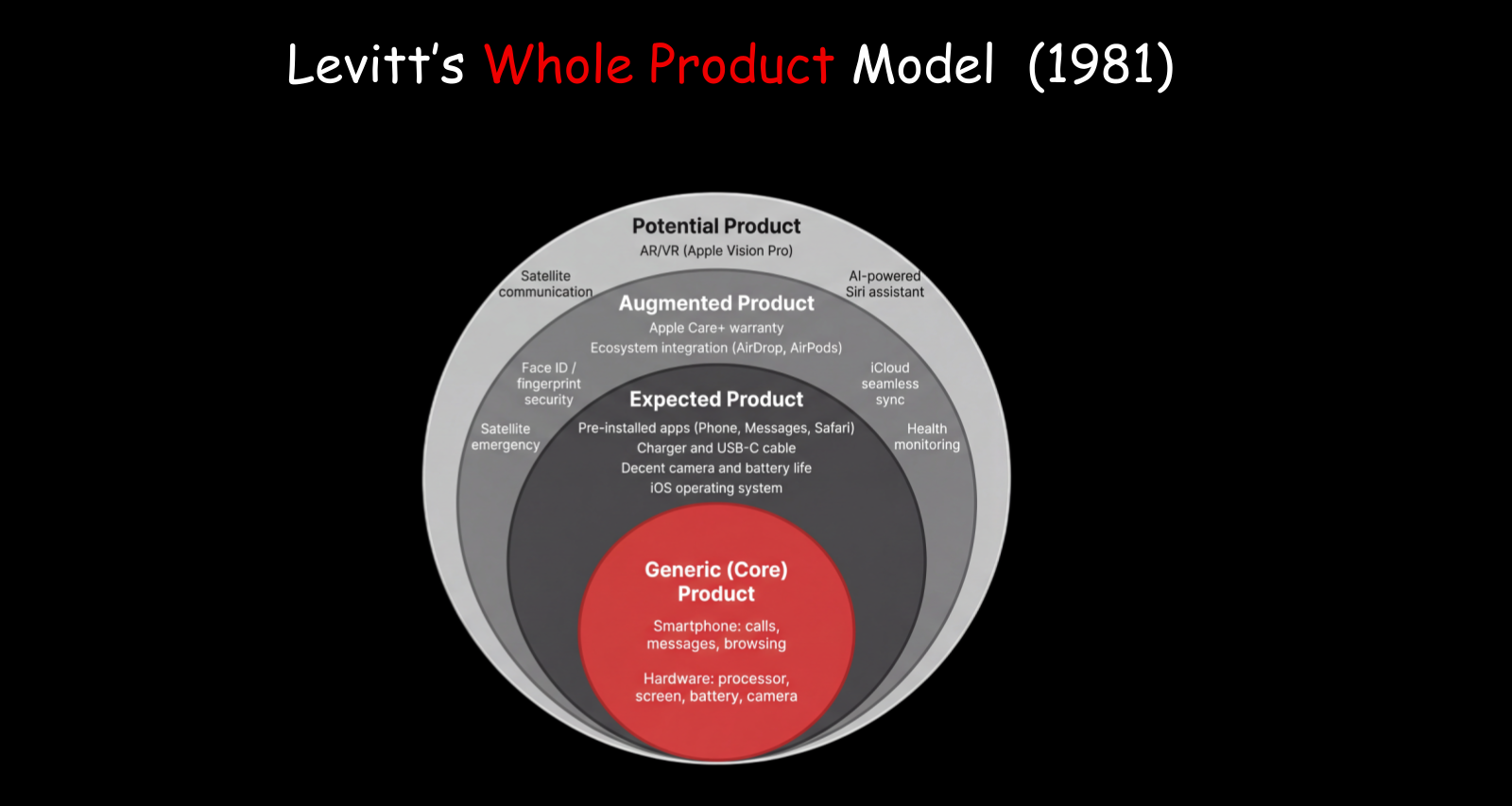
This framework is useful but a bit abstract. When you try to break down every product this way, the layers get blurry fast.
Moore Simplifies Things
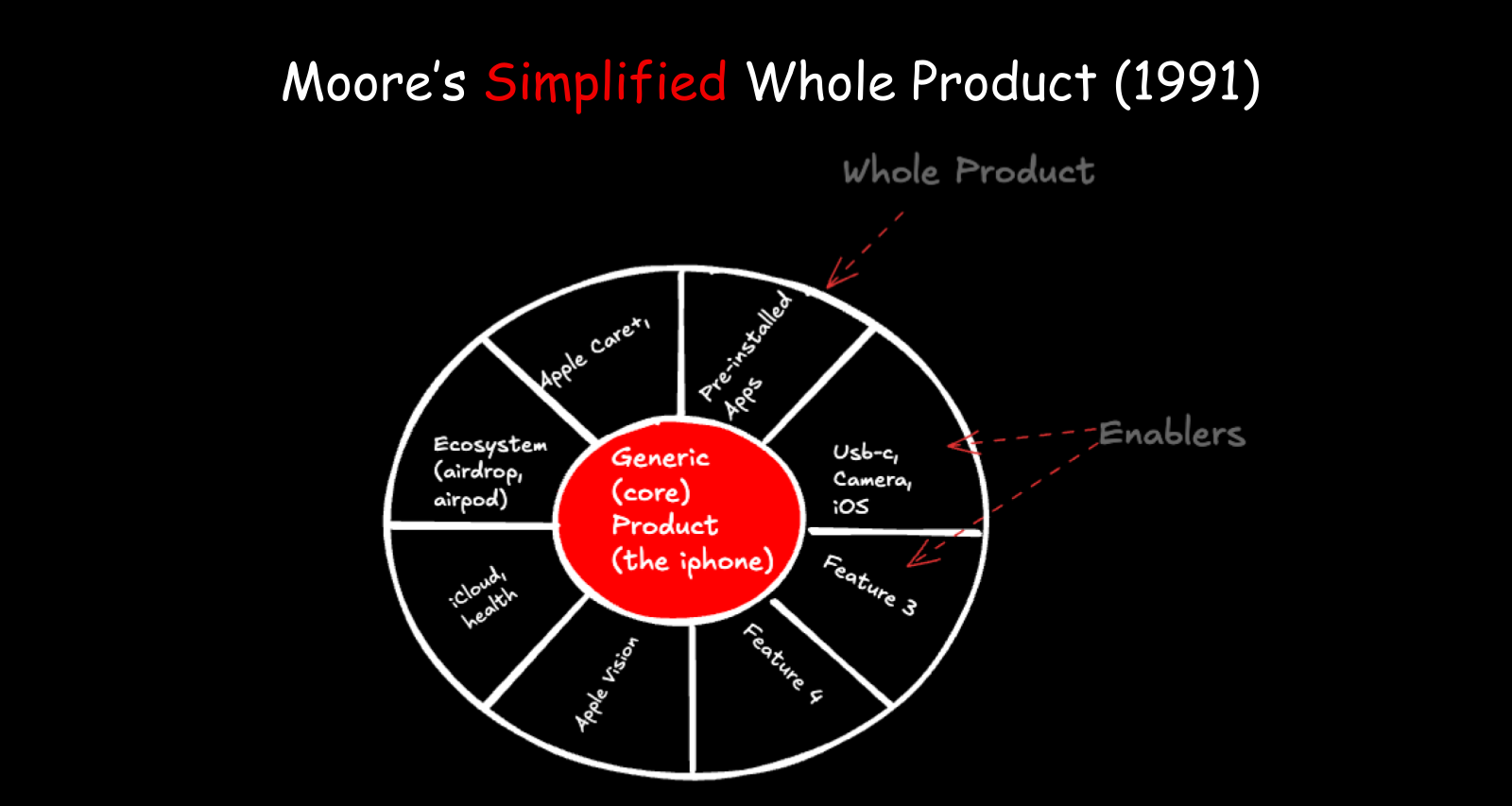
Geoffrey Moore took Levitt’s model and simplified it. Moore is best known for Crossing the Chasm (first published in 1991, revised in 2014) and its companion Inside the Tornado, both about how tech products move from early adopters to the mainstream. His version of the whole product model is more practical: you have the core product in the center, and a single surrounding layer that describes the features and activities that complete it.
Take the iPhone again. The generic product is the phone. The whole product is USB-C, pre-installed apps, Face ID, iCloud, the App Store — all the things that make it usable in practice, not just in theory.
Adding Differentiation and Constraints
I took Moore’s model and extended it. Think of it as a flower: each petal represents either a feature or an activity (like QE, support, or legal review). On top of each petal sit differentiators — the things that set your product apart in the market.
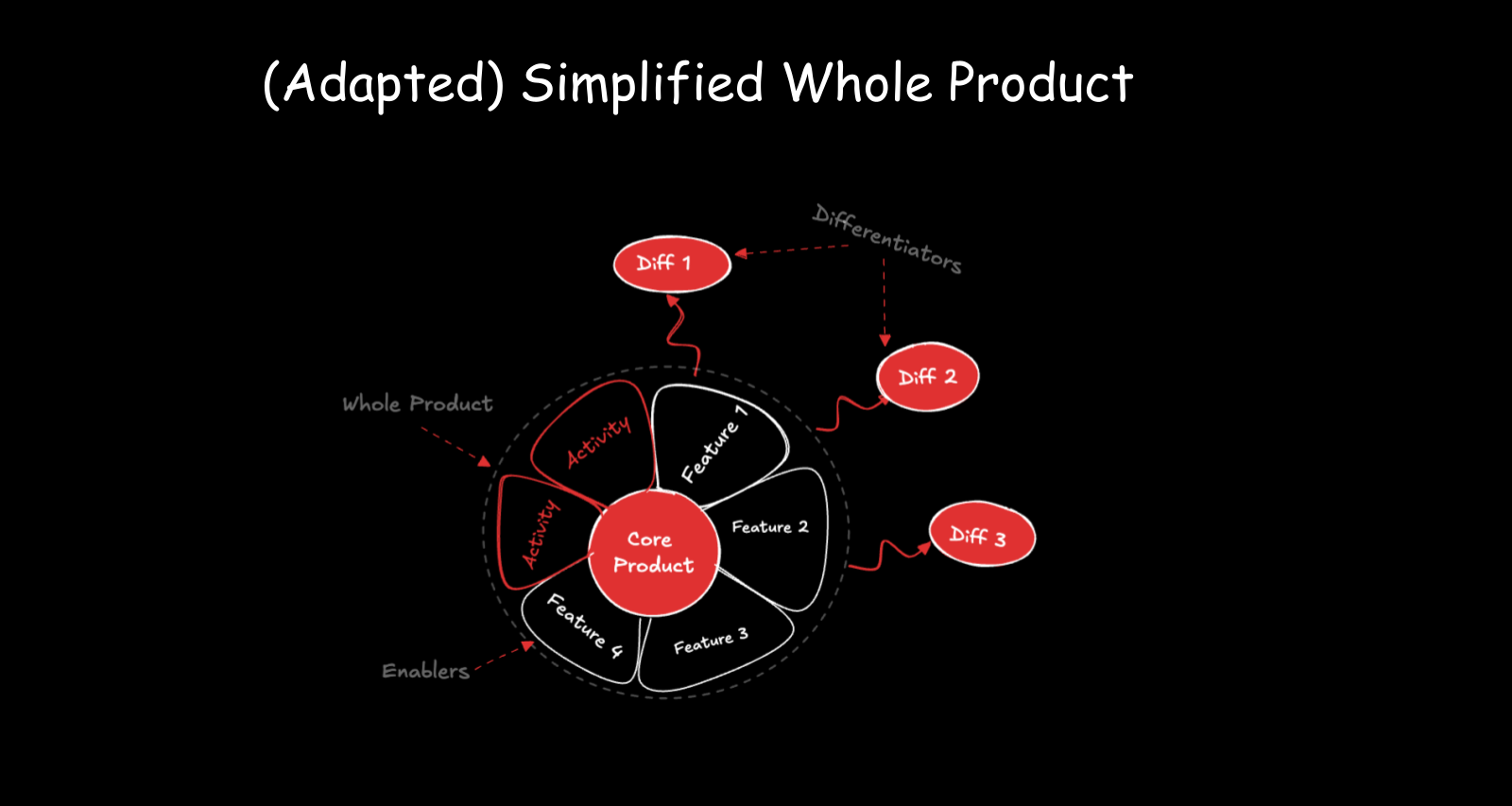
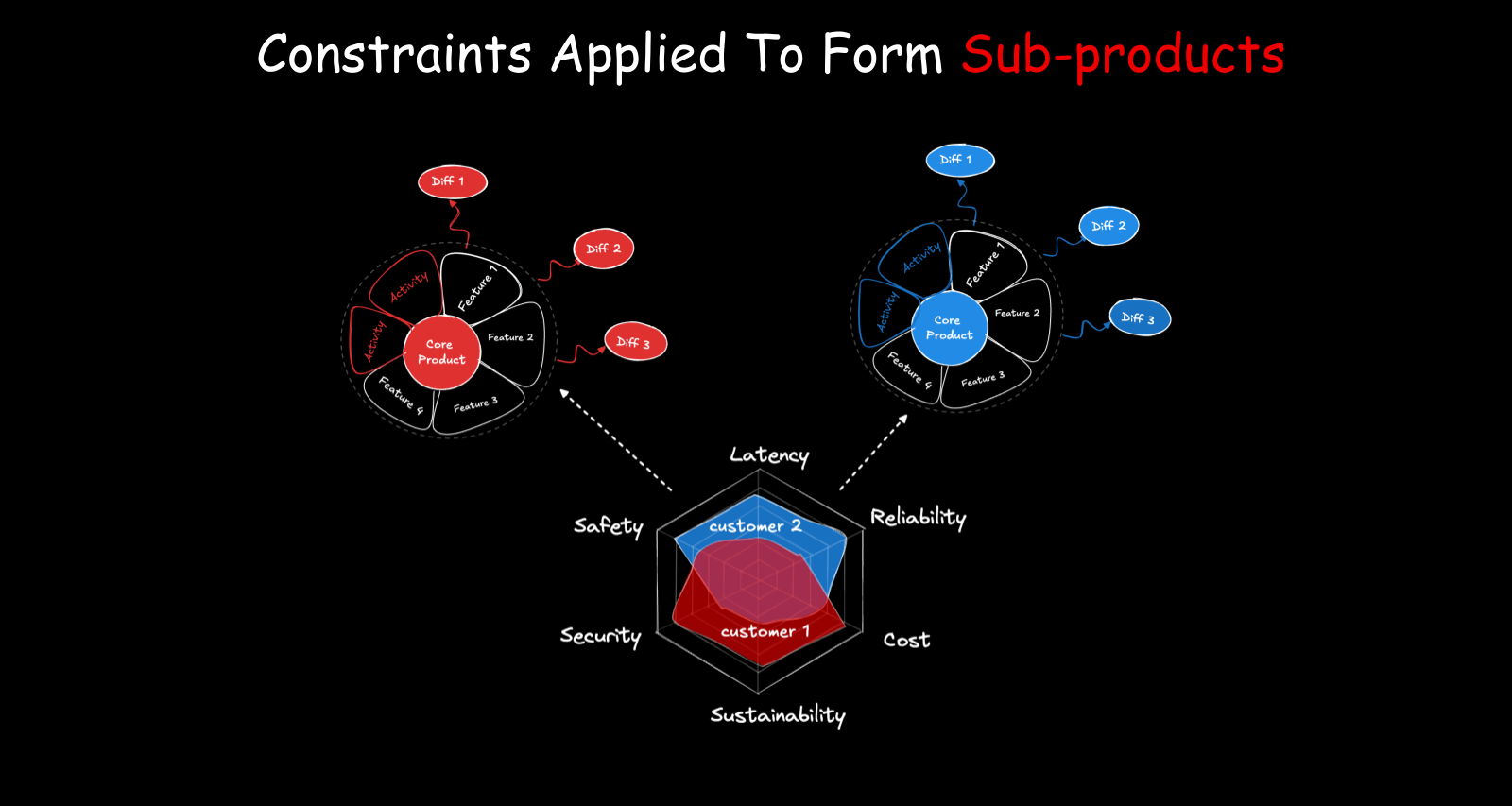
Then I added one more dimension: constraints. Different customer segments need different flavors of the same product. Constraints are what shape those flavors.
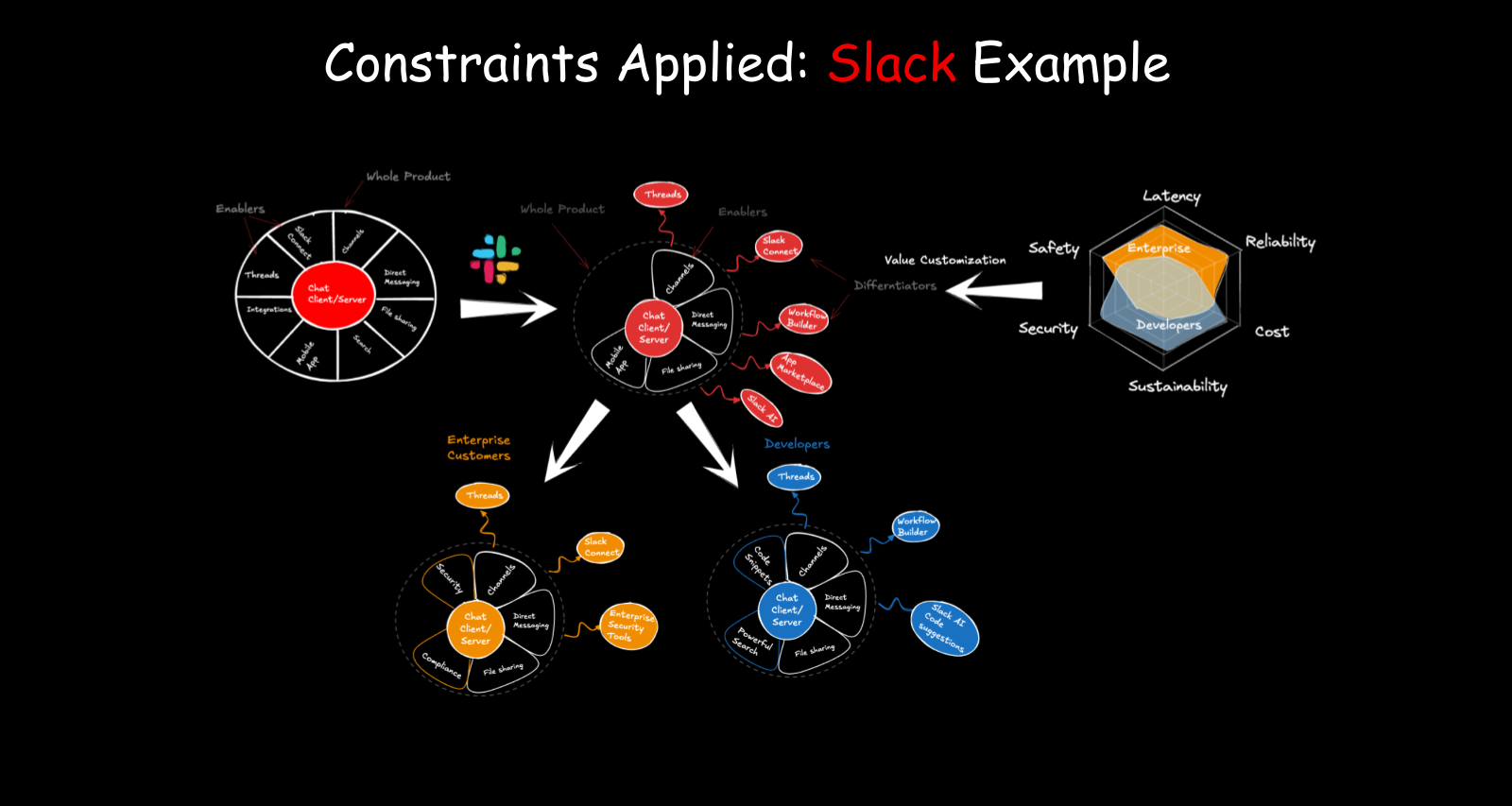
Take Slack as an example. The core product is a server that sends and receives messages. The whole product adds channels, file sharing, threaded conversations. But developer customers need different things — workflow builders, app API tokens. Enterprise customers need Slack Connect, compliance features, data residency. Same core, different constraints applied. Slack is a good case study because it shows where the whole product approach pays off: Salesforce acquired it in 2021 for $27.7 billion, and today over 750,000 organizations use it. That valuation wasn’t for the chat server — it was for the whole product around it.
Mapping to Crossing the Chasm
Moore’s Crossing the Chasm divides customers into segments:
Innovators will tolerate bugs and rough edges. They want the bleeding edge. Early adopters want something a bit more stable but are still willing to experiment. The early majority are the established companies. They want GA products with support and SLAs. And the late majority look for standards. They won’t adopt anything until it’s proven.
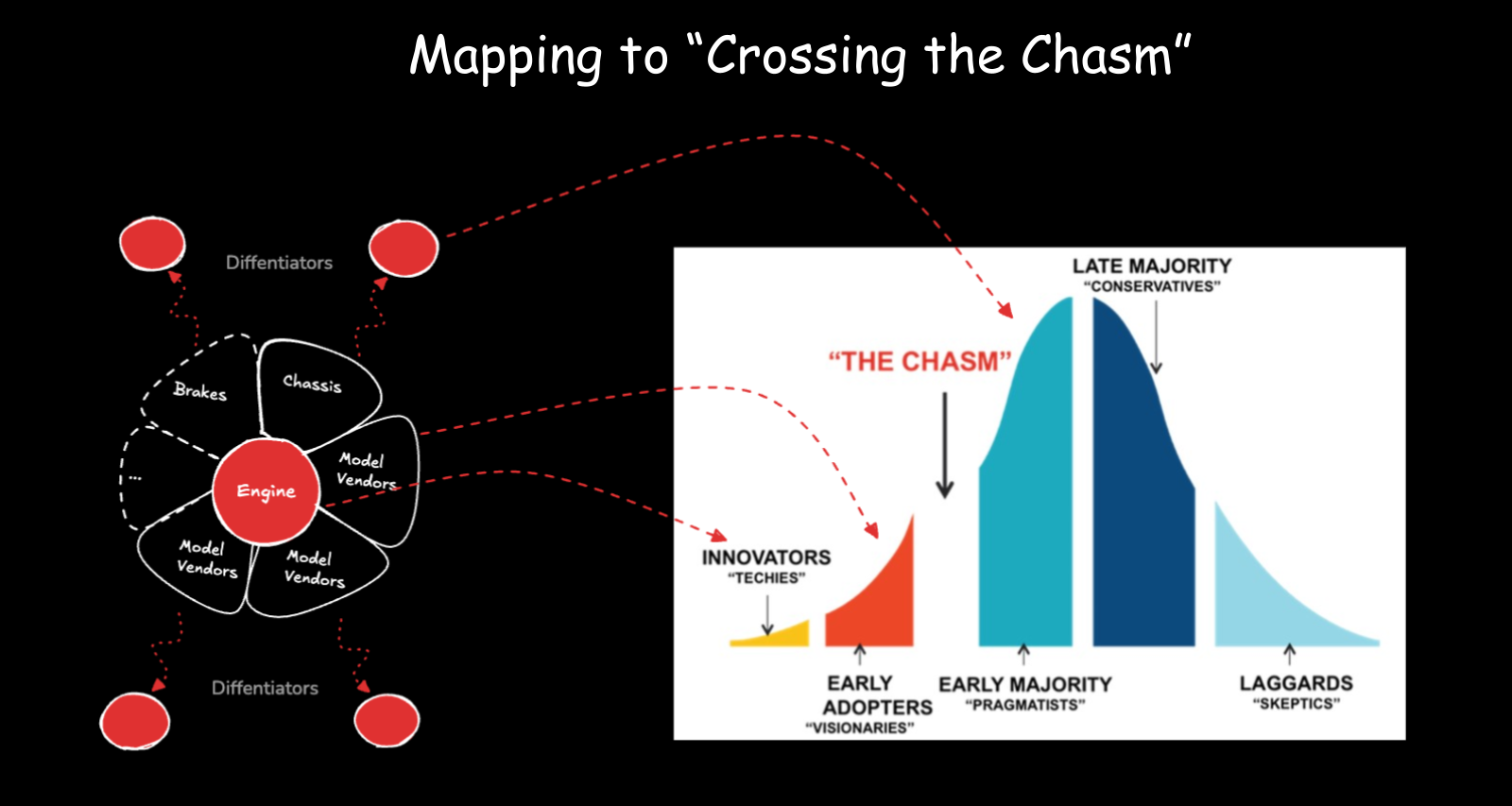
These segments map directly onto the product layers. The core product — just the MVP, the proof of concept — is enough for innovators. Add features to make it complete and you reach early adopters. Add the differentiators and you attract the early majority. Standardize everything and you get the late majority.
This is the pattern applies to AI as well. Models alone were enough for innovators. Compound AI systems (models plus tools plus context) are reaching early adopters. Whole AI products — with safety, evaluation, compliance, support — are what the early majority needs. And we’re not there yet for most use cases.
What This Means for AI Builders
If you’re building AI products today, the temptation is to focus on the model. But the model is the core — it’s necessary but insufficient. You need the whole product.
In Part 2, I’ll break down what “the whole product” actually looks like for AI: the compound systems, the agentic loop, MCP, APIs, frameworks, and runtimes that turn a model into something deployable. And in Part 3, we’ll talk about what makes one AI product defensible against another.
The model is where you start. It’s not where you finish.