Agentic Workflow for an AI Application
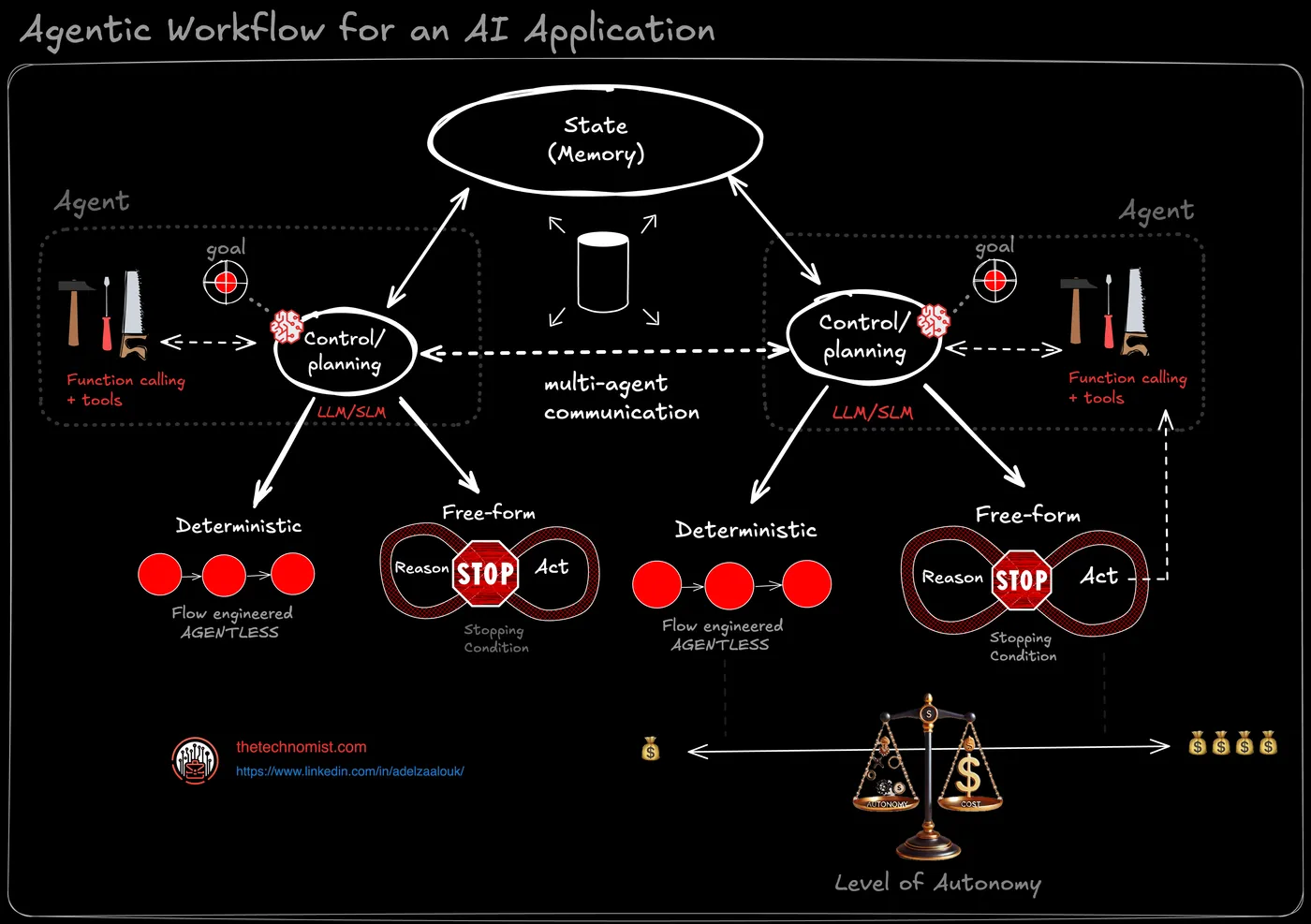
Each agent pairs an LLM planner with a goal and tools, then runs either a deterministic flow or a free-form reason-act loop. More autonomy costs more.
Contents
Use it when Deciding how much autonomy each agent in an AI application gets, and what that autonomy will cost.
An agent is a control and planning loop around an LLM or SLM. It has a goal, it can call functions and tools, and it reads and writes shared state (memory). Agents can talk to each other through multi-agent communication.
From the planner, work goes one of two ways. Deterministic: a flow-engineered, “agentless” chain of predefined steps. Free-form: a reason and act loop that runs until a stopping condition says stop.
The trade-off is the level of autonomy. On the scale, autonomy sits against cost: the deterministic path is the cheap end, the free-form loop the expensive one. Decide per agent how much autonomy the task is worth.