To Fine-Tune or Not To Fine-Tune?
Fine-tuning should not be the default answer. Rent to learn first, try RAG and smaller fixes, and only then make fine-tuning cost-effective.
Contents
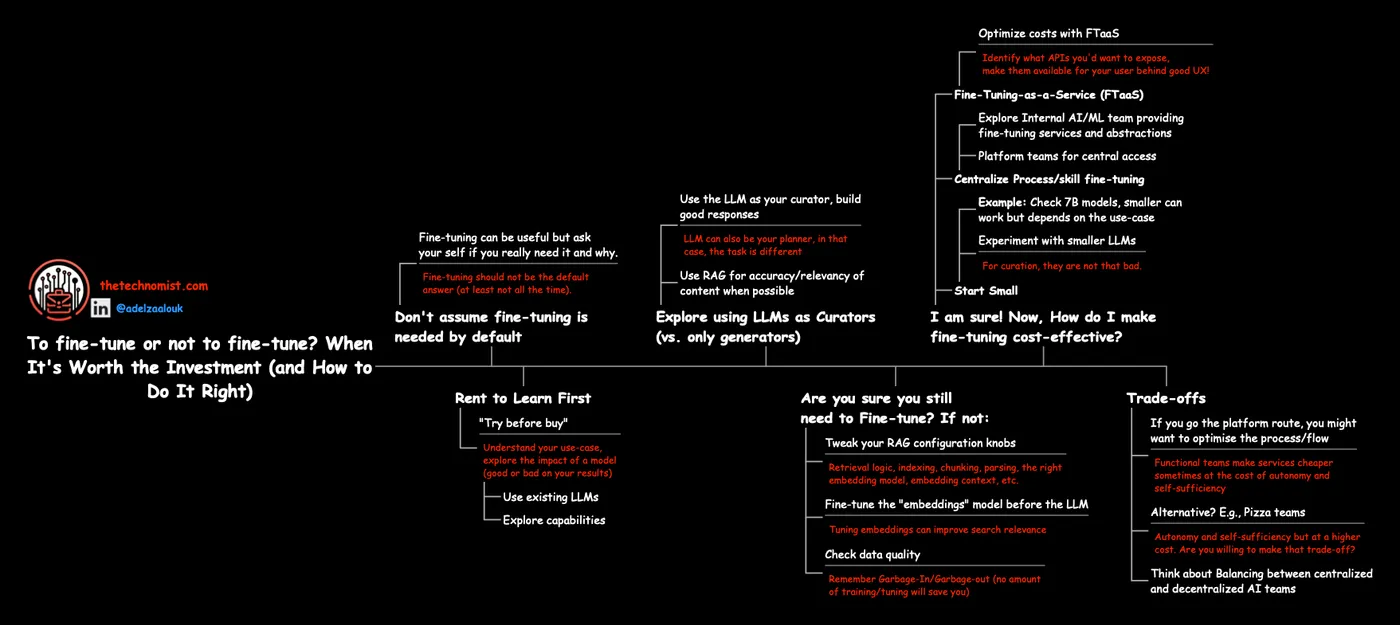
Use it when Someone on the team proposes fine-tuning a model before anyone has tried an existing one on the use case.
Don’t assume fine-tuning is needed by default. It can be useful, but ask yourself if you really need it and why.
Rent to learn first. Try before you buy: use existing LLMs, explore their capabilities, and understand the impact of a model on your results. Explore using LLMs as curators, not only generators, and use RAG for accuracy and relevancy of content when possible.
Are you still sure? If not: tweak your RAG configuration knobs, fine-tune the embeddings model before the LLM, and check data quality. Garbage in, garbage out; no amount of training or tuning will save you.
If you are sure, make it cost-effective. Start small, experiment with smaller LLMs, and centralize the skill, for example through fine-tuning as a service from a platform team. That last step is a trade-off: central teams make services cheaper, sometimes at the cost of autonomy and self-sufficiency.