The Market Share Power Law
The AI market follows a power law: a few incumbents at the head hold most of the share, compute and data, and a long tail of niche companies holds the rest.
Contents
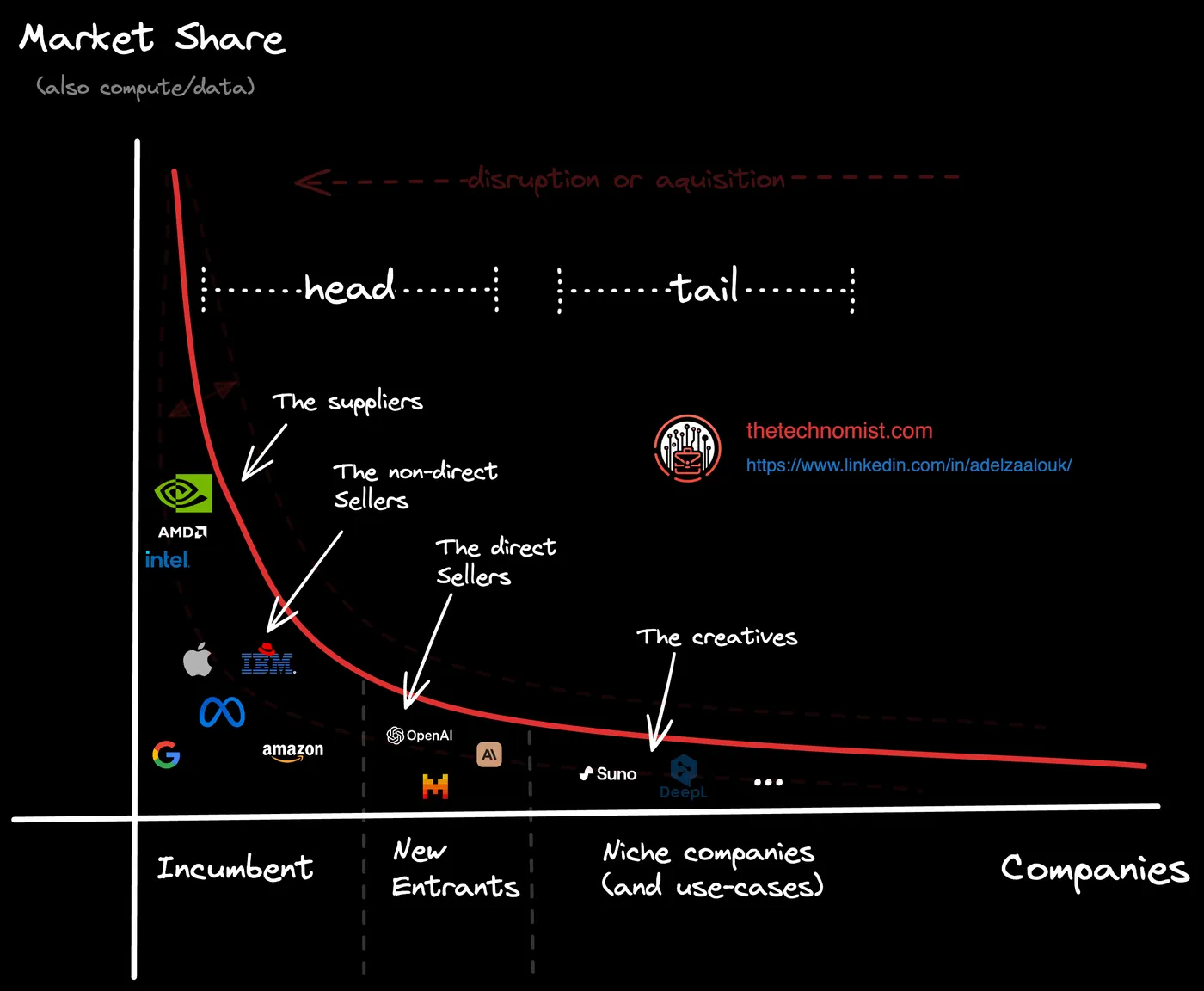
Use it when Placing an AI company on the market map and asking whether it supplies, sells AI directly, sells it indirectly, or serves a niche.
“The AI market, as it stands today, seems to exemplify a power-law.” The curve plots market share, and also compute and data, against companies: “a minority of companies have access to the majority of compute/data.”
- Incumbents at the head. The suppliers (NVIDIA, AMD, Intel) and the non-direct sellers (Apple, IBM, Meta, Google, Amazon), for whom the model is “the proxy” for an existing business.
- New entrants. The direct sellers (OpenAI, Anthropic, Mistral), for whom “the model is the product.”
- Niche companies and use cases in the tail. The creatives, such as Suno and DeepL.
A dashed arrow runs from the tail back toward the head, labelled “disruption or acquisition.”