How Agents Run
There is no shared language for how agents run. Name the execution mode and the scale, and the infrastructure decision sits at their intersection.
Contents
Use it when An agent infrastructure debate goes in circles because nobody has said what kind of agents, or how many.
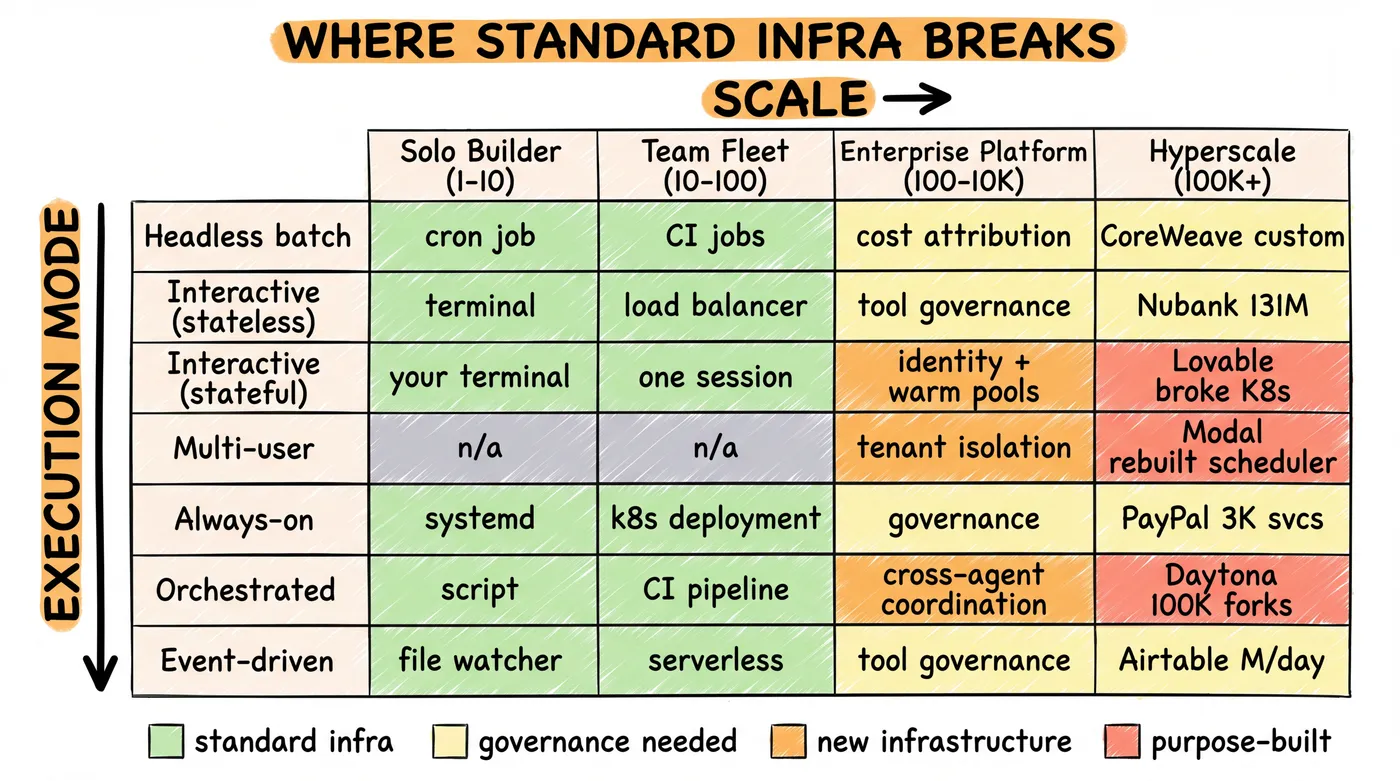
We keep saying “agent” for workloads with different lifecycle, state and isolation needs, then wonder why the infrastructure advice conflicts. Two questions settle it: what kind of agents, and how many?
Six execution modes:
- Headless batch. Starts, works, finishes, nobody watching.
- Interactive. Stateless (chat, respond, forget) or stateful (a live workspace with files and processes).
- Multi-user platform. Each user gets an isolated workspace.
- Always-on autonomous. Watches, detects, acts, and must survive restarts.
- Orchestrated. A coordinator delegates to sub-agents in separate failure domains.
- Event-driven. Wakes on a trigger, works, scales to zero.
Four scale archetypes: solo builder (1 to 10), team fleet (10 to 100), enterprise platform (100 to 10K), hyperscale (100K+).
Neither dimension tells the full story alone. Batch, stateless, always-on and event-driven agents map to workload shapes that already exist. Stateful, multi-user and orchestrated agents need per-user environments and coordination most enterprises have never built. Agent pilots stall there.