Cheap Building, Scarce Judgment
When AI makes building cheap, more things get shipped, so the person who decides what not to build matters more, not less.
Contents
Use it when Someone proposes dropping the PM role because everyone on the team can now vibe-code a prototype.
The builder model says: everyone codes, everyone talks to customers, everyone ships. The translation layer between idea and prototype really is compressing, from weeks to hours.
But “everyone can code” is not “everyone can build.” Making a demo work is engineering on easy mode. Making it work reliably, securely, at scale, for years, is still hard.
It also misdiagnoses the PM bottleneck. The meetings exist because someone has to:
- Align stakeholders who want conflicting things.
- Say no to most feature requests without making enemies.
- Turn messy customer signals into a strategy.
None of these get easier because a PM can write code.
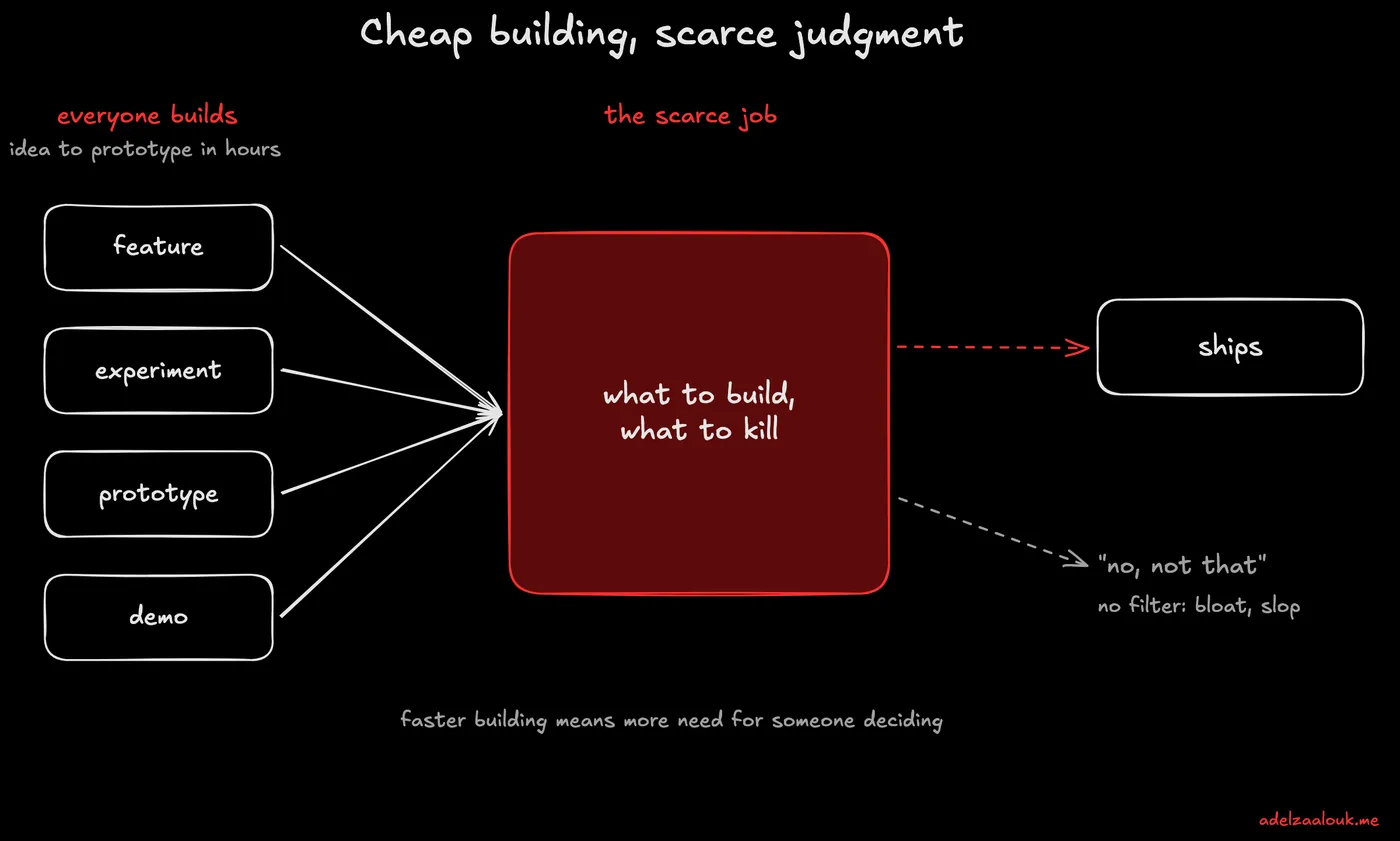
Faster building means more need for someone deciding what to build. When shipping is cheap, you get more features, experiments and prototypes. Without a filter you get bloat, slop and inconsistent UX. Cheap building makes the person who says “no, not that” more important.
The builder model fits small teams, developer tools and low-stakes internal tools. At scale, roles don’t dissolve; “what to build, what to kill” becomes the scarce skill.