Less to Read
You can't make humans read faster. Make verification cheaper by restructuring the work so there is less for them to read.
Contents
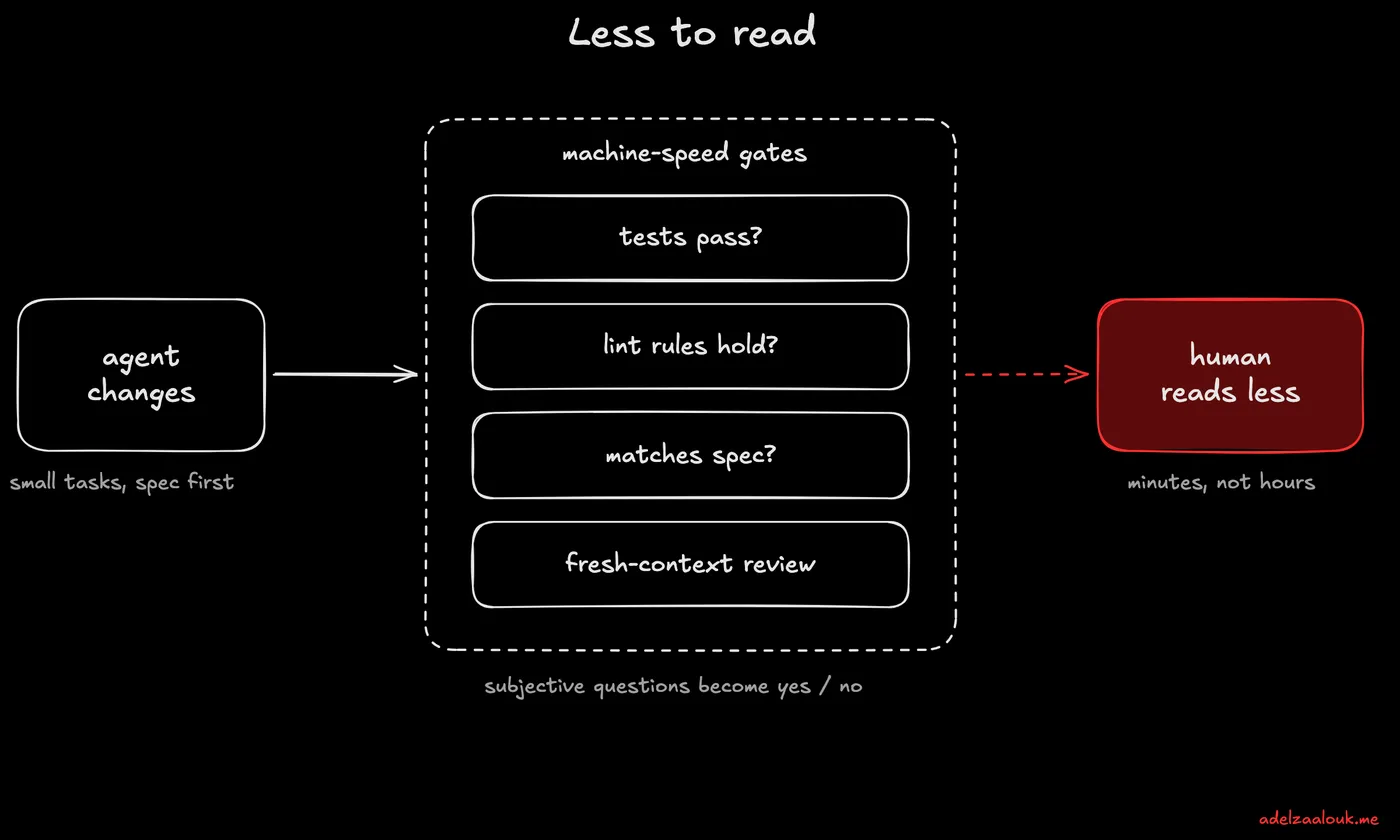
Use it when AI-generated changes are piling up in your review queue faster than people can read them.
If verification is the bottleneck, make verification cheaper. Not by hiring more reviewers. Not by trusting AI more. By restructuring how work gets done so less verification is needed, and what remains is faster.
Each pattern turns a subjective question into one with a clear answer:
- Red/green TDD. “Does this code work?” becomes “do the tests pass?”
- Define the outcome, not the solution. Review shifts from “is this the right approach?” to “does it meet the acceptance criteria?”
- Linters as law. Every mistake caught in review becomes a lint rule, so you never review it again.
- Small tasks. Changes small enough to review in minutes, not hours.
- Spec before code. “Does the output match the spec?” is answerable; “is this what we wanted?” is a conversation.
- Automated gates and fresh-context review. Verification that runs at machine speed instead of human speed.
The patterns compound. Each one saves a little verification time. Stacked together, they shift the ratio.