The Instruction Budget
Every always-loaded instruction competes for the model's attention. Keep only lines whose removal would cause mistakes; move everything else to where it loads when needed.
Contents
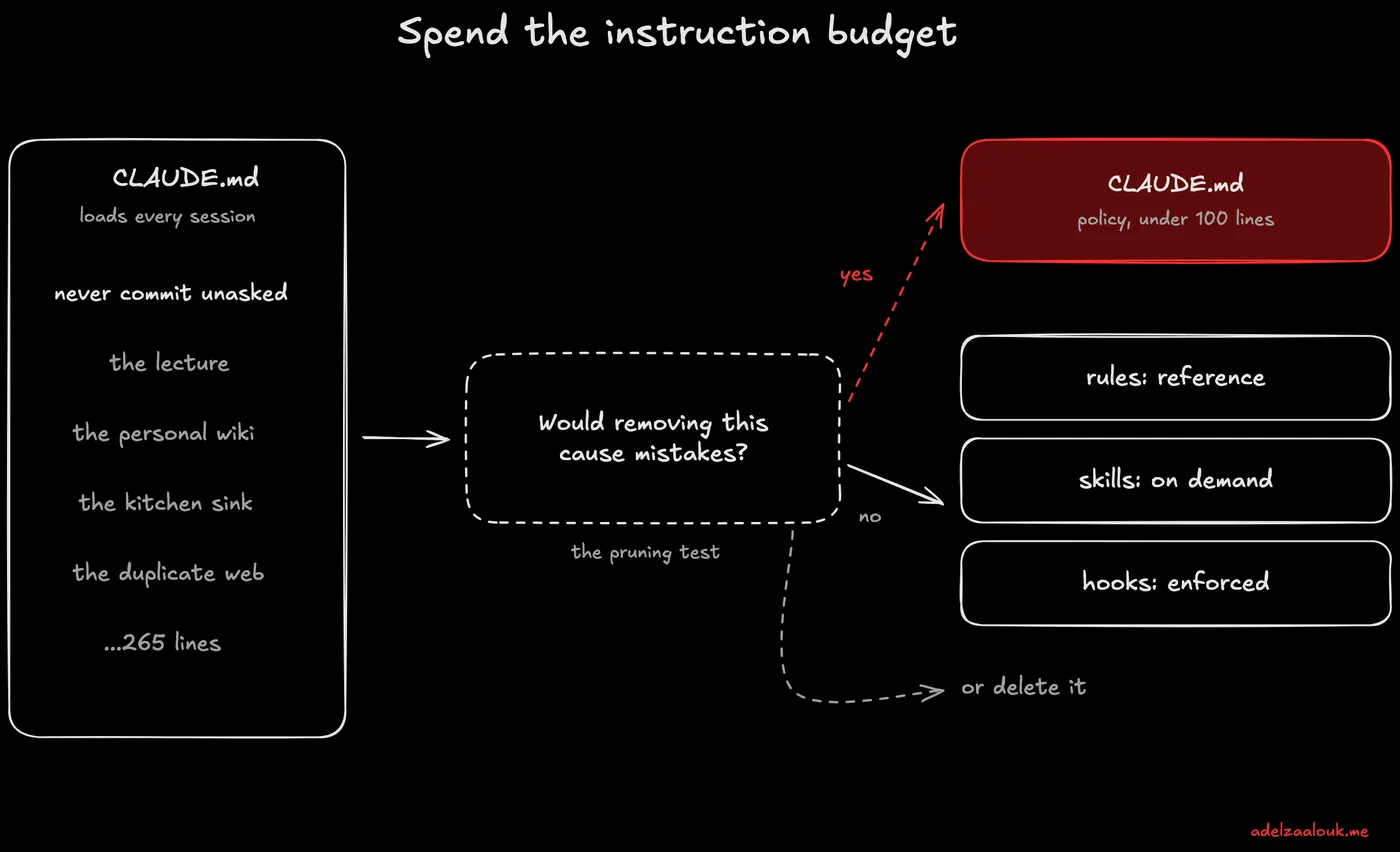
Use it when Your agent keeps ignoring rules in a CLAUDE.md or rules file that has grown long.
Your instruction budget is overdrawn. Every line in your CLAUDE.md loads into every session, relevant or not. The cost isn’t just tokens. It’s attention: important rules compete with obvious ones, and sometimes lose.
The pruning test. For every line, ask: “Would removing this cause Claude to make mistakes?” If not, delete it. Not “is this good advice?” The question is whether the model specifically needs it.
What usually fails the test:
- The lecture: principles the model already knows.
- The personal wiki: documentation for you, not instructions for the model.
- The kitchen sink: policy and reference material in one file.
- The duplicate web: the same rule in several files, sometimes in conflict.
Put each instruction where it belongs:
- CLAUDE.md for policy, every session.
- Rules for reference, every session or by glob.
- Skills for workflows, on demand.
- Hooks for enforcement that must happen every time.
Prune it like code. A focused set of instructions the model follows beats an exhaustive manual it mostly ignores.