Outcome Loops
Put a rubric-graded quality gate between the agent's output and the user: a separate judge scores, the agent revises until the rubric passes or the budget runs out.
Contents
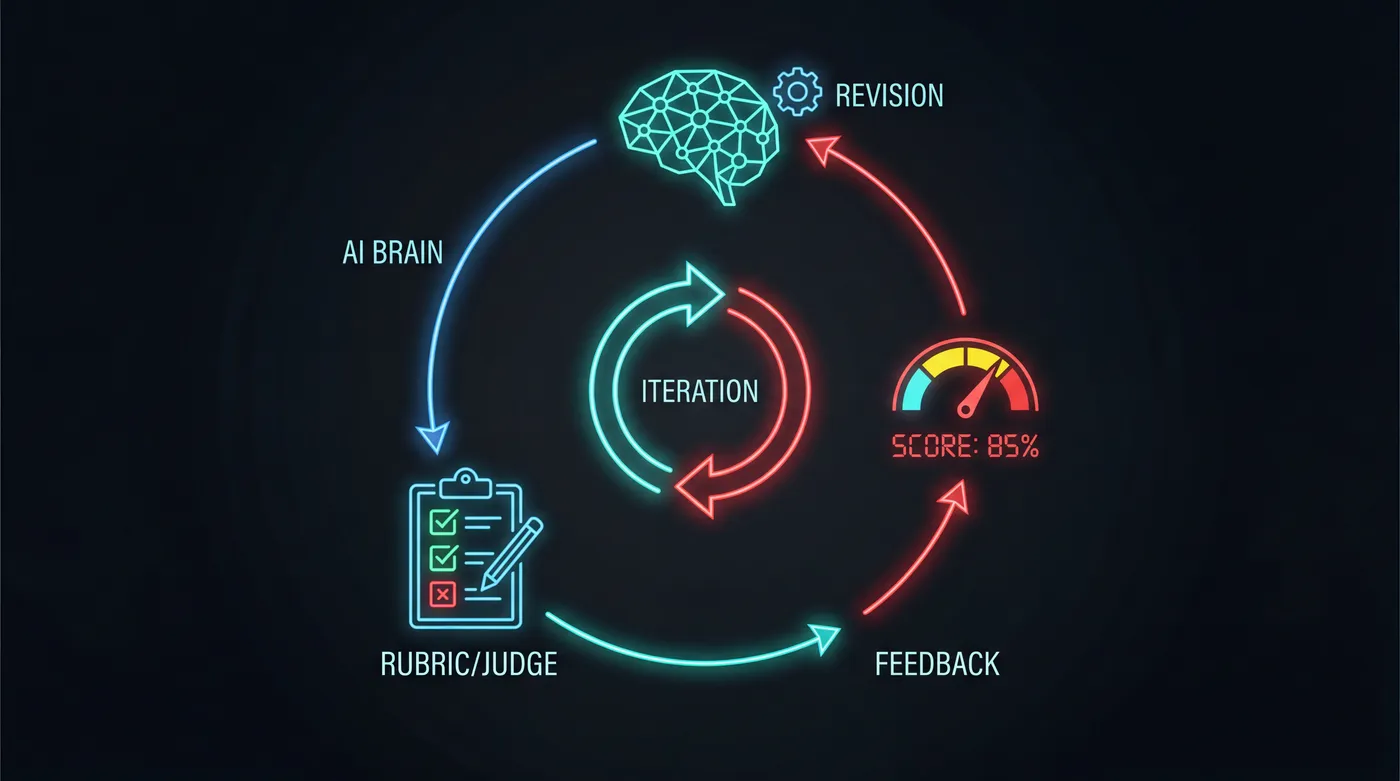
Use it when Agent output is usually fine but rarely first-draft ready, and you keep fixing it by hand.
An outcome loop is a judge call between the agent’s output and the user’s inbox. The agent finishes its work. A separate judge, which does not see the agent’s reasoning, scores the final output against a rubric. Fail, and the score and feedback go back for revision. Pass, and the output ships.
It wraps around the agentic loop as a quality gate; it does not replace it.
Three lessons from running it:
- Build the judge first. A lenient judge passed everything on the first try and the loop never fired. A strict one made the loop valuable. The judge is the investment, not the loop.
- Stop at the first pass. More iterations can make things worse: one model went 4, 8, 10, 9, 8, fixing the original problems and then adding new ones.
- Start the rubric loose. The rubric is a product. The one you start with will not be the one you end with: tighten where the judge is too lenient, loosen where it is too strict.
Humans still validate the judge.