Every Layer Counts
No single control is enough to secure an AI agent. Stack six layers, and design each one assuming the layer above it has already failed.
Contents
Use it when Reviewing an agent deployment that relies on one control, such as a container or a guardrail, to keep it safe.
We are handing root-level capabilities to systems that can be tricked by a well-crafted paragraph. When a chatbot hallucinates, you get a wrong answer. When an agent hallucinates, it might delete the wrong directory or post your credentials to an external endpoint.
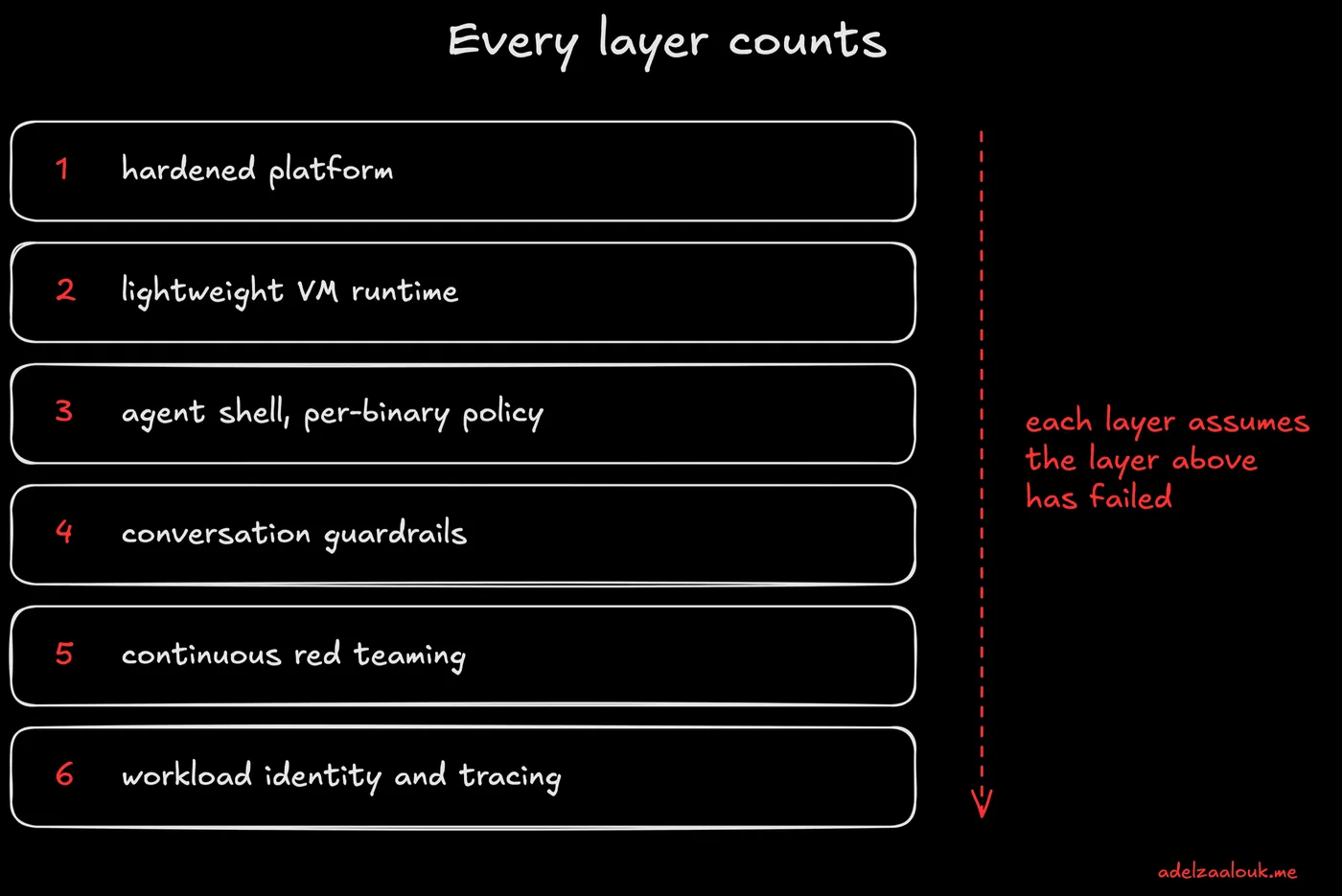
No single control is enough. Putting an agent in a container is not a sandbox; it is a suggestion. The teams that deploy agents safely use six layers:
- Hardened platform: locked-down pods, SELinux, DNS-based egress filtering.
- Lightweight VM runtimes: an escape lands in a throwaway VM, not the host node.
- Agent shell with per-binary policy: node can reach the API, but curl spawned by a prompt injection cannot.
- Conversation guardrails: intercept injections before the model and gate every tool call.
- Continuous red teaming: attack yourself first and feed findings back into guardrails.
- Workload identity and tracing: every agent gets a cryptographic identity, every tool call is traced.
Each layer assumes the one above has failed. Start with the assumption that the agent will be compromised. The question is whether your stack limits the impact when it does.